Operator Platform - Commission Plans
The article describes the types and settings of commission plans, available options, and qualifications.
In this article
How to Add Commission Plan. General Settings.
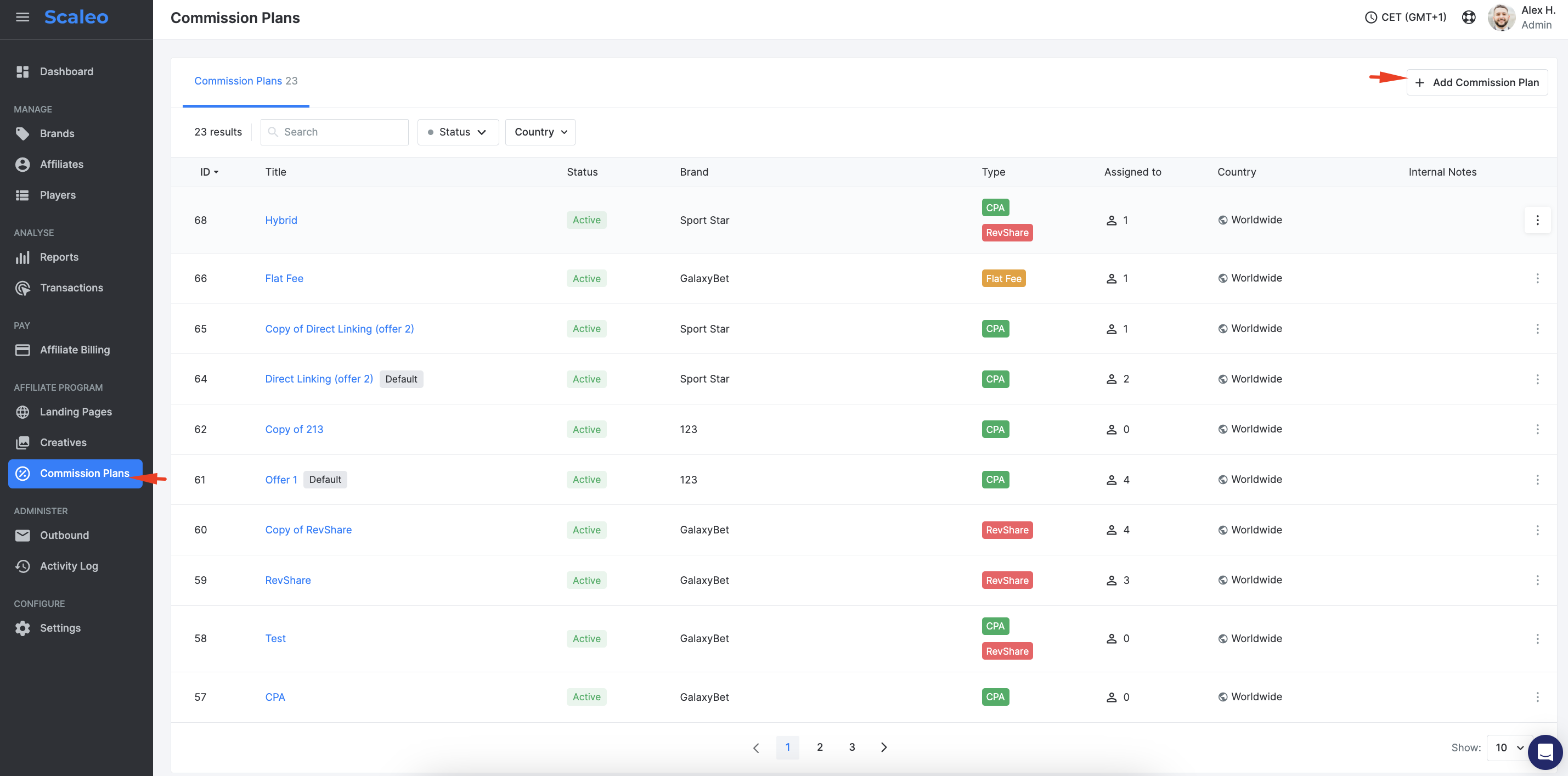
To set up and manage Commission Plans, navigate to the Commission Plans section in the side menu. This section is presented as a list of existing plans, where a manager can add a new plan, duplicate an existing one, or delete an outdated one.
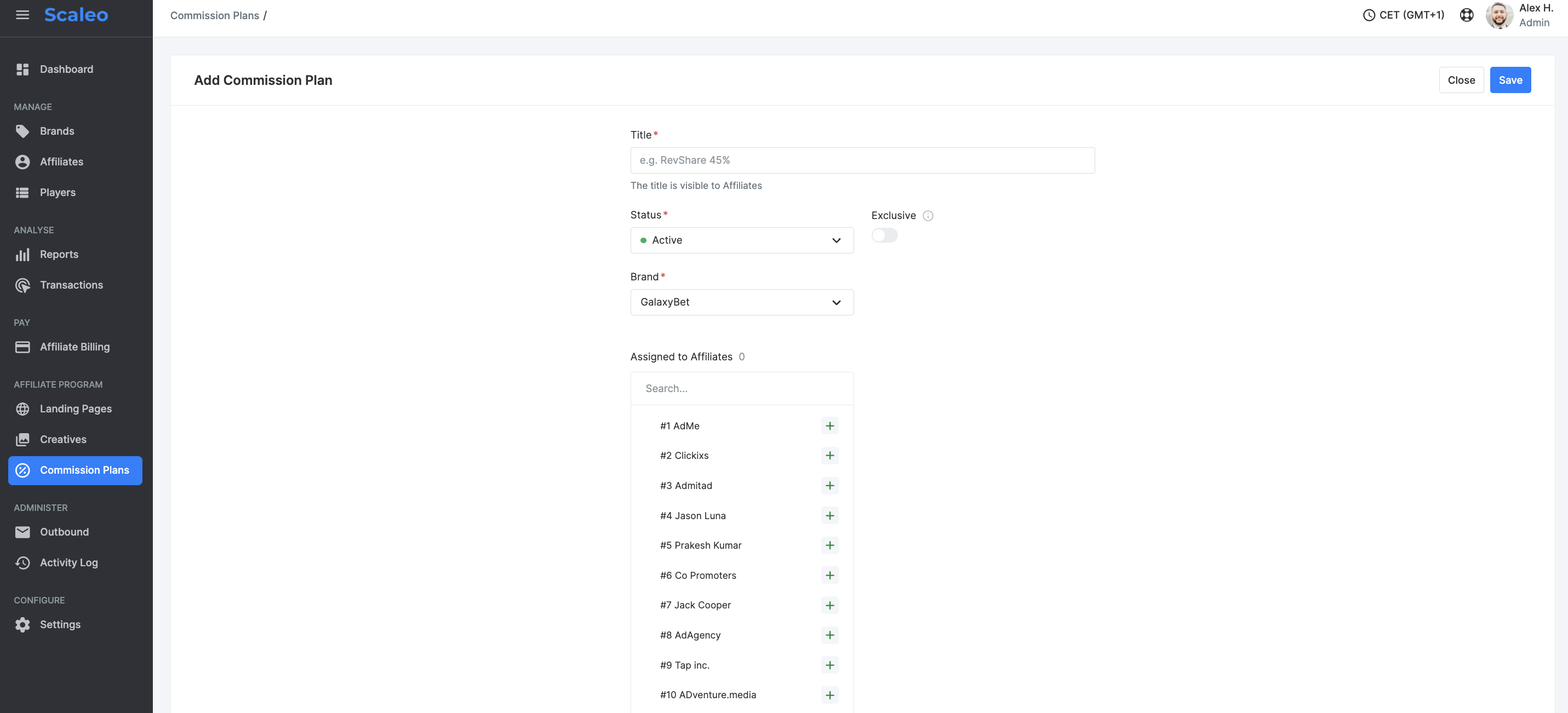
To add a new commission plan, go to the Commission Plans section and click on the + Add Commission Plan button. In the next menu, fill in the basic fields that are standard for any commission plan:
- Title - The name of the new Commission Plan that will be available to affiliates.
- Status - The available options are: active, paused, inactive.
- Active – the default status. The commission plan is available for affiliates to select, and payouts are made according to the configured settings.
- Paused – not available for selection by partners, but payouts for already referred players are still processed.
- Inactive – not visible to partners, and no payouts are calculated or processed.
- Toggle "Exclusive" - The Commission Plan will be displayed with an "Exclusive" label in the Affiliate Portal.
- Brand or Product - By default, the primary brand will always be used unless there is more than one brand or product connected to the platform.
- Assigned to Affiliates - By default, the platform always has a default Commission Plan assigned to all newly registered affiliates. Managers can customize and assign new Commission Plans to specific affiliates and create individual Commission Plans for them. The default plan can be changed on request by the Scaleo support team.
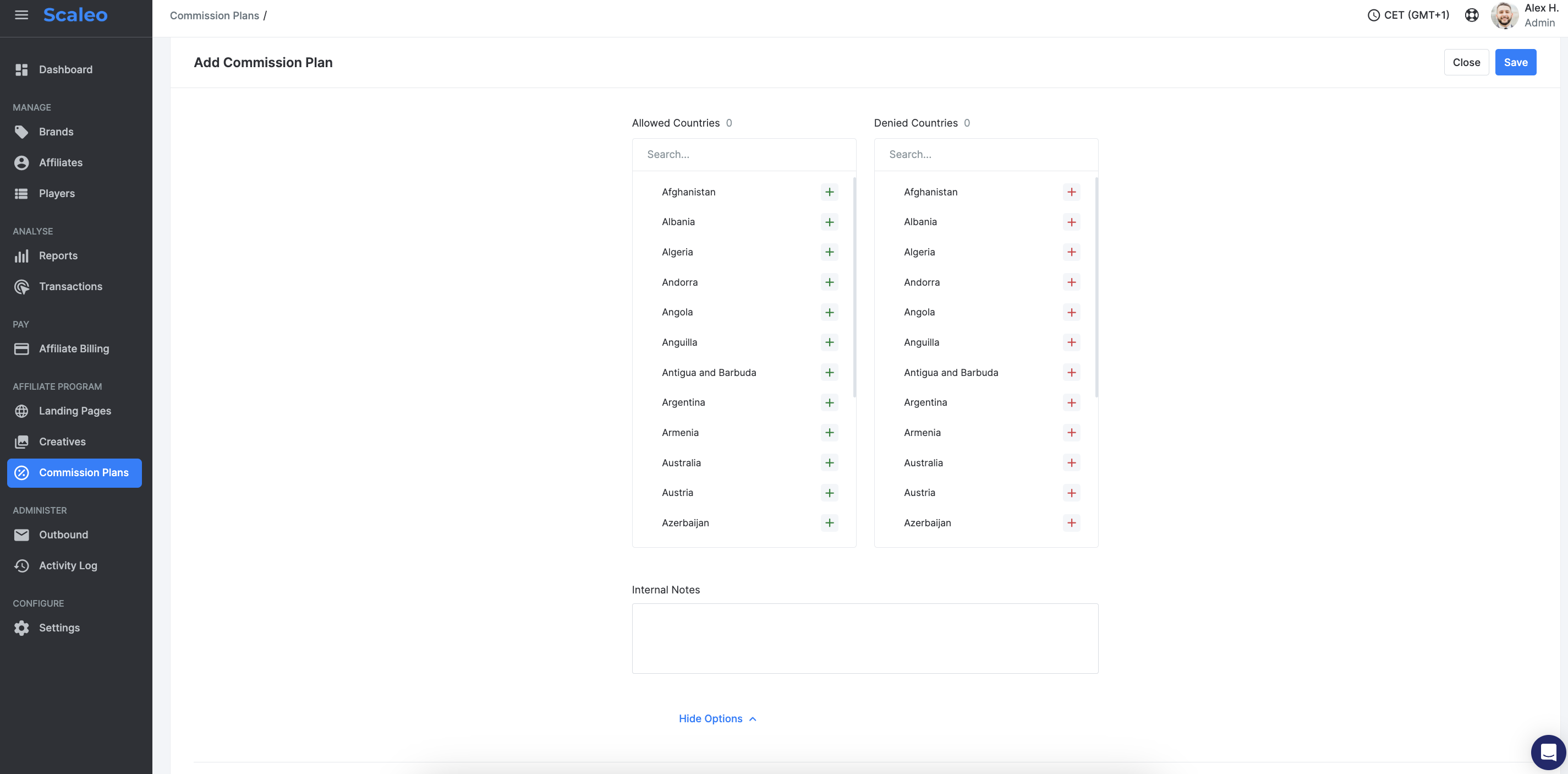
- Advanced Options: Allowed/Denied Countries - This option allows you to configure targeting for specific traffic by country. You can specify allowed and/or prohibited countries in the settings. No commissions will be generated for affiliates whose players are from restricted regions.
- Internal notes is an option that allows managers to leave internal comments that are visible only to platform managers.
CPA Commission Plan
Let's take a closer look at the CPA (Cost Per Acquisition) Commission Plan model.
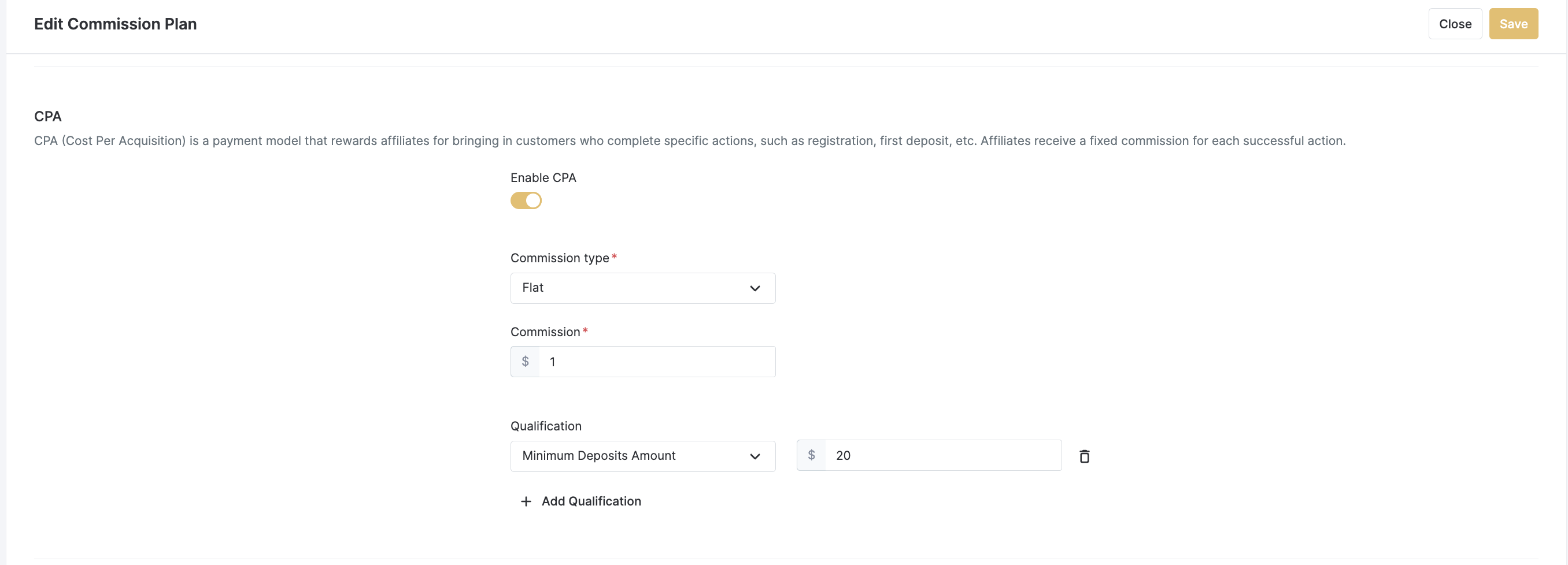
CPA (Cost Per Acquisition) is a payment model that rewards affiliates for bringing in customers who complete specific actions, such as registration, making a first deposit, etc. Affiliates receive specified commissions for the successful actions of their players.
The CPA model is popular as it aligns the affiliate's interests with those of the business — payment is only made when a desired outcome is achieved. This makes it a performance-based model, often seen in various online marketing strategies.
Benefits for iGaming Operators:
For operators, CPA plans are attractive as they imply payment for actual results (i.e., new active players).
CPA commission plans in iGaming are designed to incentivize affiliates to focus on driving high-quality traffic that converts into new, active players, offering them a fixed payout for each successful acquisition. This model balances the interests of both the affiliate and the iGaming operator, ensuring that payouts are tied directly to measurable results.
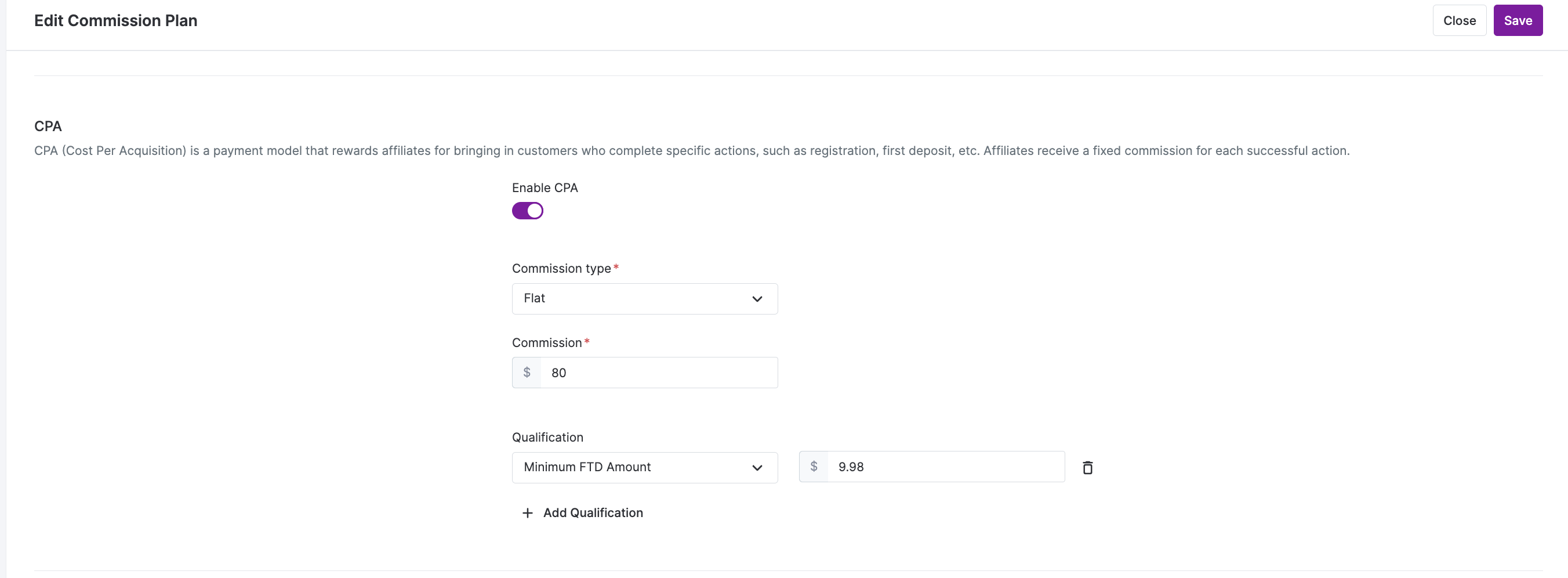
CPA Сommission Plans have the following settings options:
- Flat - fixed commission.
- Flat by Countries - refers to a commission structure that applies a fixed rate across different countries.
- Progressive - refers to a commission structure that increases in steps or tiers based on certain criteria. For example, according to the Commission Plan, an affiliate might earn a higher commission as they achieve higher deposit volumes.
- Range by FTD Amount - This refers to commission tiers or bands that are determined based on the total monetary value of First Time Deposits (FTD). Affiliates are rewarded based on how much money new players deposit for the first time. For example, different commission percentages may apply if the total FTD amount falls within specific ranges, such as $0-$500, $500-$1000, etc.
- Monthly FTD Count - This refers to the number of First Time Deposits made within a month. It is a metric used to evaluate the performance of affiliates based on the volume of new depositing players they bring to the platform within a specific month. Affiliates might be incentivized with higher commissions for reaching certain monthly FTD count thresholds.
- Range by Total Deposits - This is a tiered commission structure based on the total number of deposits made by players. Unlike FTD, this includes all deposits, not just the first ones. Affiliates earn commissions based on the cumulative deposit activity of their referred players, with different rates applied depending on the total deposit amount across all players.
- Range by Deposits Amount - Similar to "Range by Total Deposits," but this specifically refers to the total monetary value of deposits made by players, rather than the count of deposits. Affiliates are rewarded based on the total value of all deposits, with different commission rates applied as the total deposit amount increases.
- Progressive by Countries - builds on the progressive model with differentiation based on the country. This means that the progressive structure can vary from country to country. Each country might have its own set of tiers or progressive steps based on specific conditions.
List of possible qualification options for CPA configuration
- Minimum FTD Amount - Sets the minimum amount of the first deposit that a player must make to qualify for commission calculations.
- Minimum Deposits Count - Specifies the minimum number of deposits that a player must make over a certain period to be eligible for commission calculations.
- Minimum Deposits Amount - Requires the total sum of all deposits made by a player to reach a certain minimum amount to qualify for commission calculations.
- Minimum Bets - Determines the minimum number of bets a player must place to be considered eligible.
- Minimum Bets Amount - Sets the minimum amount of money that a player must bet (e.g., on games, sports events, etc.) to qualify for commission calculations.
- Minimum Trades - Specifies the minimum number of trades (e.g., in financial markets) that a trader must complete to qualify for commission calculations.
- Minimum Trades Volume (Lots) - Sets the minimum trading volume (usually measured in lots) that a trader must achieve to qualify.
- Minimum Days since Registration - Determines the minimum number of days that must pass since a player or trader’s registration to be qualified.
- Maximum Days since Registration - Sets the maximum number of days after which a player or a trader no longer qualifies for commission calculations.
- Player Status - It allows specifying the status a player must have (e.g., active, new, etc.) for their activity to be taken into account in commission calculations.
- Trader Status - Similar to player status, but applies to traders; indicates the status a trader must have to include their activity in commission calculations.
These qualifications help manage traffic quality and ensure necessary conditions are met before commissions are paid out to affiliates.
RevShare Commission Plan
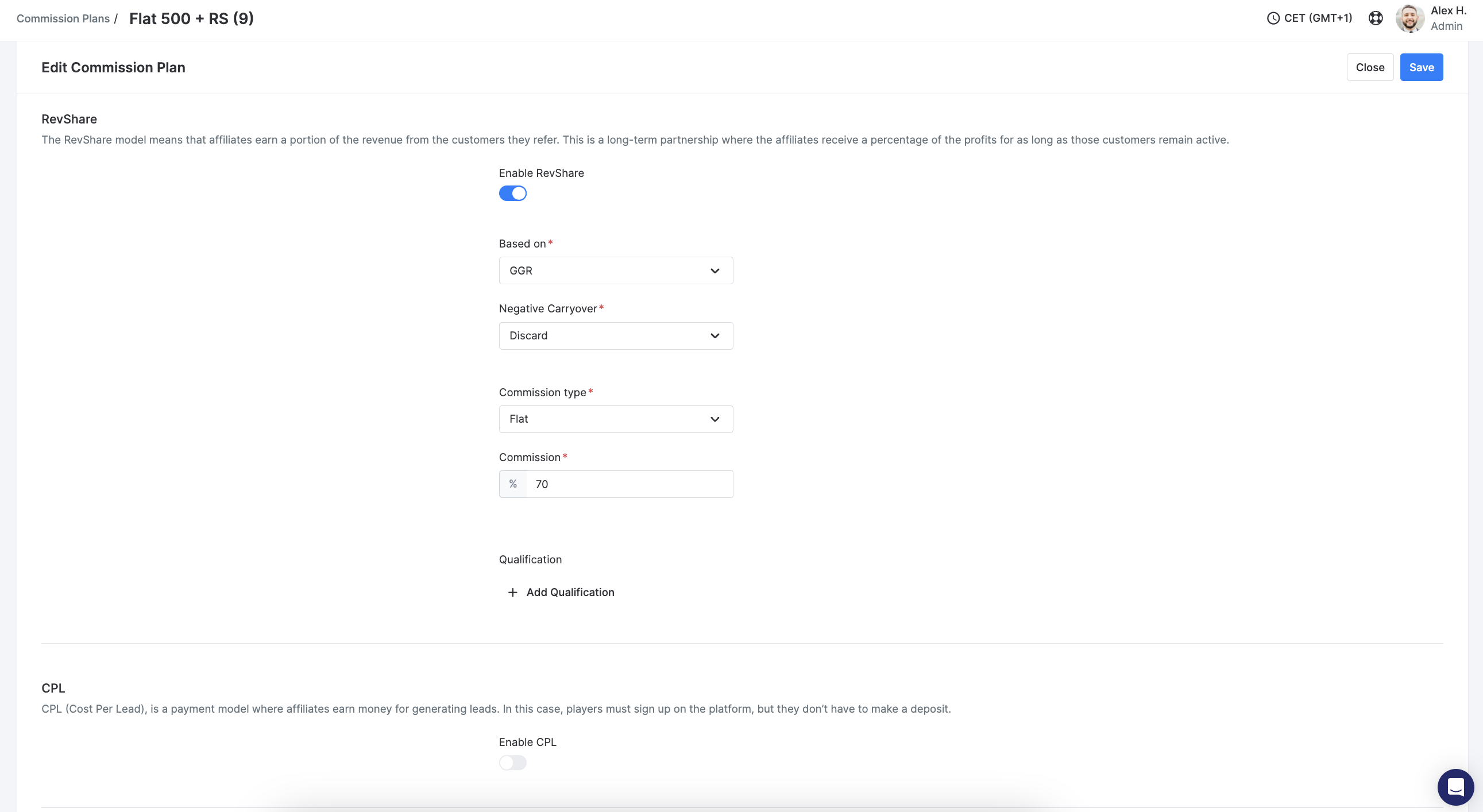
A RevShare (Revenue Share) model is very popular in iGaming. The model is used by affiliate programs to compensate affiliates who drive traffic to online gambling platforms, such as casinos, sportsbooks, and poker sites. Under this plan, affiliates earn a percentage of the net revenue generated by the players they refer to an iGaming site.
In the highly competitive iGaming industry, RevShare plans align the interests of both the affiliate and the operator by focusing on long-term player value rather than short-term gains. This model is particularly attractive to affiliates who have a deep understanding of the gaming industry and are skilled at driving and retaining high-value players.
Therefore, a RevShare Commission Plan in iGaming is a win-win for both affiliates and operators, provided that the affiliate is capable of driving valuable, long-term players to the platform. It offers the potential for significant long-term earnings but comes with the risk of fluctuating income based on player behavior.
Example of a RevShare Plan in iGaming:
An iGaming platform may offer affiliates a 30% RevShare deal. If a referred player generates $1,000 in NGR (after deducting bonuses, player winnings, and any other costs), the affiliate would earn $300 for that player.
Available options for configuring a RevShare commission plan:
- Based on:
- Negative Carryover: In iGaming, Negative Carryover refers to how negative balances (usually resulting from player winnings) are handled in affiliate commission calculations.
- Commission type:
- Range by FTD Amount: This refers to setting commission tiers or ranges based on the total value of First-Time Deposits (FTD) made by players. For example, different commission rates could be applied based on whether the FTD amount is $100, $500, or $1,000.
- Monthly FTD Count: This involves setting commission ranges based on the number of First-Time Deposits (FTDs) made within a month. Affiliates might receive higher commissions if they generate a larger number of FTDs in a given month.
- Monthly GGR (Gross Gaming Revenue): This refers to the total revenue generated from gaming activities before any deductions like taxes or bonuses. The commission might vary based on the GGR accumulated over a month.
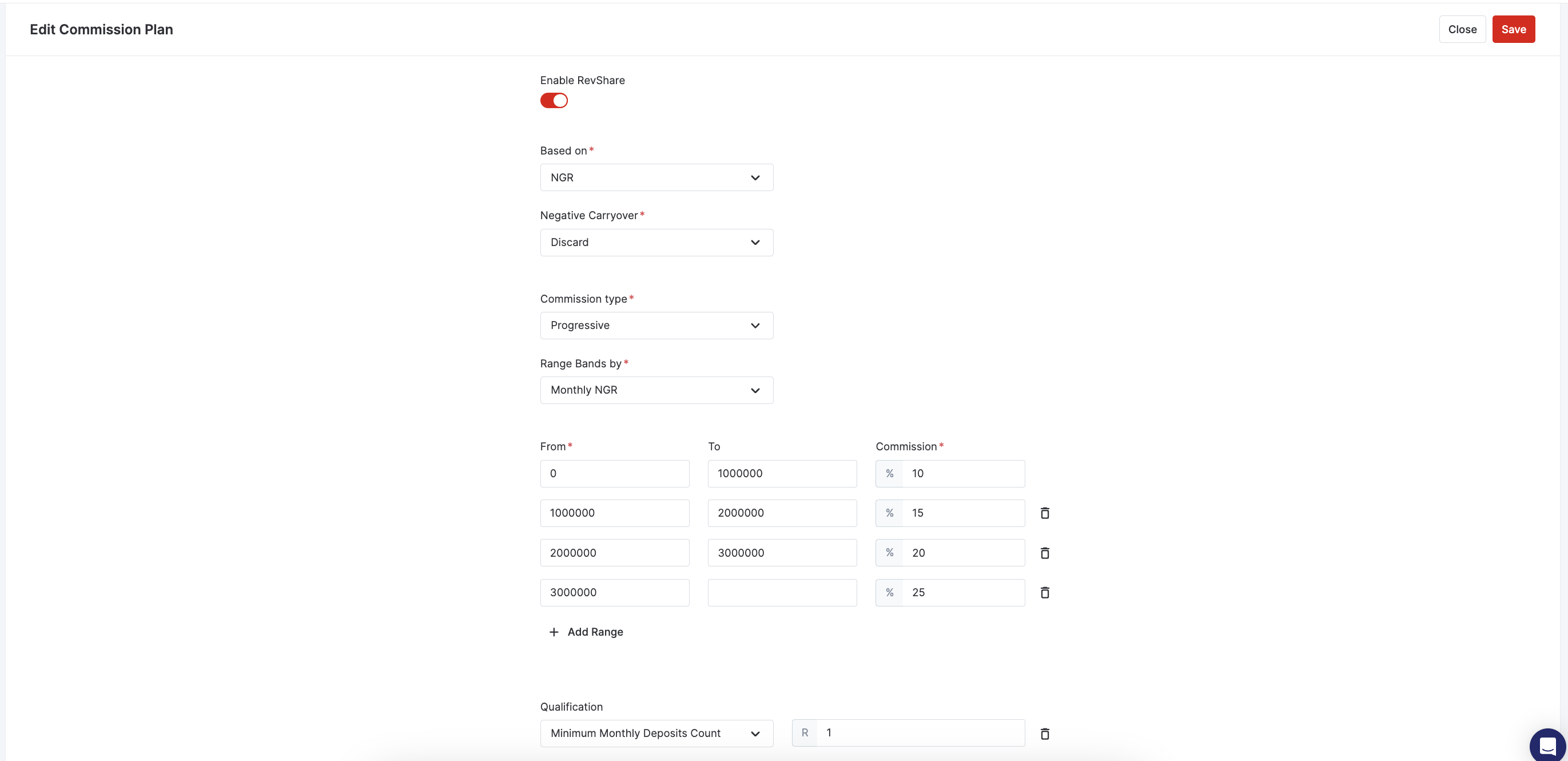
- Monthly NGR (Net Gaming Revenue): NGR is the revenue remaining after deductions such as bonuses, taxes, and fees from the GGR. Commissions are often structured around the NGR, with affiliates earning different percentages based on the monthly NGR.
- Monthly Revenue: This can refer to the total revenue generated by a player or group of players within a month, which may include both gaming and non-gaming activities. Commissions can be structured based on the total monthly revenue.
- Monthly Total Deposits: This is the cumulative amount of all deposits made by players in a month. Commission plans might use this metric to determine how much an affiliate earns, with higher commissions for higher deposit totals.
- Monthly Deposits Amount: Similar to Monthly Total Deposits, this refers specifically to the sum of all deposits made by players in a month. Commission structures could be designed to reward affiliates based on these cumulative deposit amounts.
- Range by FTD Amount
- Monthly FTD Count
- Monthly GGR (Gross Gaming Revenue)
- Monthly NGR (Net Gaming Revenue)
- Monthly Revenue
- Monthly Total Deposits
- Monthly Deposits Amount
- - GGR
- - NGR
- - Revenue
-
Discard: This option means that the negative balance is reset to zero at the start of a new period (usually the beginning of the next month). Affiliates will not have to recover the negative balance before earning new commissions.
-
Deduct from Balance: With this option, the negative balance is carried over to the next period, meaning it will be deducted from future earnings. Affiliates will need to offset this negative balance with positive earnings in the following period before they can receive any new commissions.
- - Flat
- - Flat by Countries
- - Progressive:
- - Progressive by Countries:
List of possible qualification options for RevShare configuration
- Minimum FTD Amount: This qualification sets a minimum threshold for the amount a player must deposit as their First-Time Deposit (FTD) for the affiliate to earn a commission. If the player's initial deposit meets or exceeds this amount, the commission is triggered.
- Minimum Monthly Deposits: This refers to the minimum number of deposits a player must make in a given month for the affiliate to qualify for commissions. The focus is on the frequency of deposits rather than their amount.
- Minimum Monthly Deposits Amount: This qualification sets a minimum cumulative amount that a player’s deposits must reach within a month for the affiliate to earn a commission. It ensures that commissions are paid only when players deposit a substantial amount overall.
- Minimum Monthly Bets: This sets a minimum number of bets or wagers that a player must place in a month for the affiliate to earn commissions. It is often used to ensure that players are actively participating and not just registering without engaging.
- Minimum Monthly Bets Amount: This refers to the minimum total monetary amount that a player must wager in a month for the affiliate to receive a commission. It incentivizes the promotion of more engaged players who bet higher amounts.
- Minimum Monthly Trades: In the context of trading platforms, this sets a minimum number of trades that a player must execute within a month for the affiliate to earn commissions. This ensures that affiliates are rewarded for bringing in active traders.
- Minimum Monthly Trades Volume (Lots): This qualification requires a minimum volume of trades (measured in lots) that a player must complete in a month. It is particularly relevant in Forex and CFD trading where the volume of trades is a critical metric.
- Minimum Days since Registration: This refers to the minimum number of days that must pass after a player’s registration for the affiliate to be eligible for commission. It is used to ensure that commissions are paid for long-term players rather than immediate sign-ups.
- Maximum Days since Registration: This sets a limit on the number of days since a player's registration after which an affiliate is no longer eligible to earn commissions on that player. It encourages affiliates to focus on acquiring and activating new players.
- Player Status: This refers to the current status or level of a player (e.g., active, inactive, VIP). Commissions may vary depending on the player's status, with higher commissions often paid for VIP or highly active players.
- Trader Status: Similar to Player Status, this qualification relates to the status of a trader (active, dormant, VIP) on trading platforms. Commissions might be adjusted based on the trader's activity and engagement level.
- Total RevShare Commission Limit: This sets a maximum cap on the amount of revenue share (RevShare) commission that an affiliate can earn from a single player or a group of players over a specified period. It prevents excessively high payouts and helps manage costs for the platform.
CPL Commission Plan
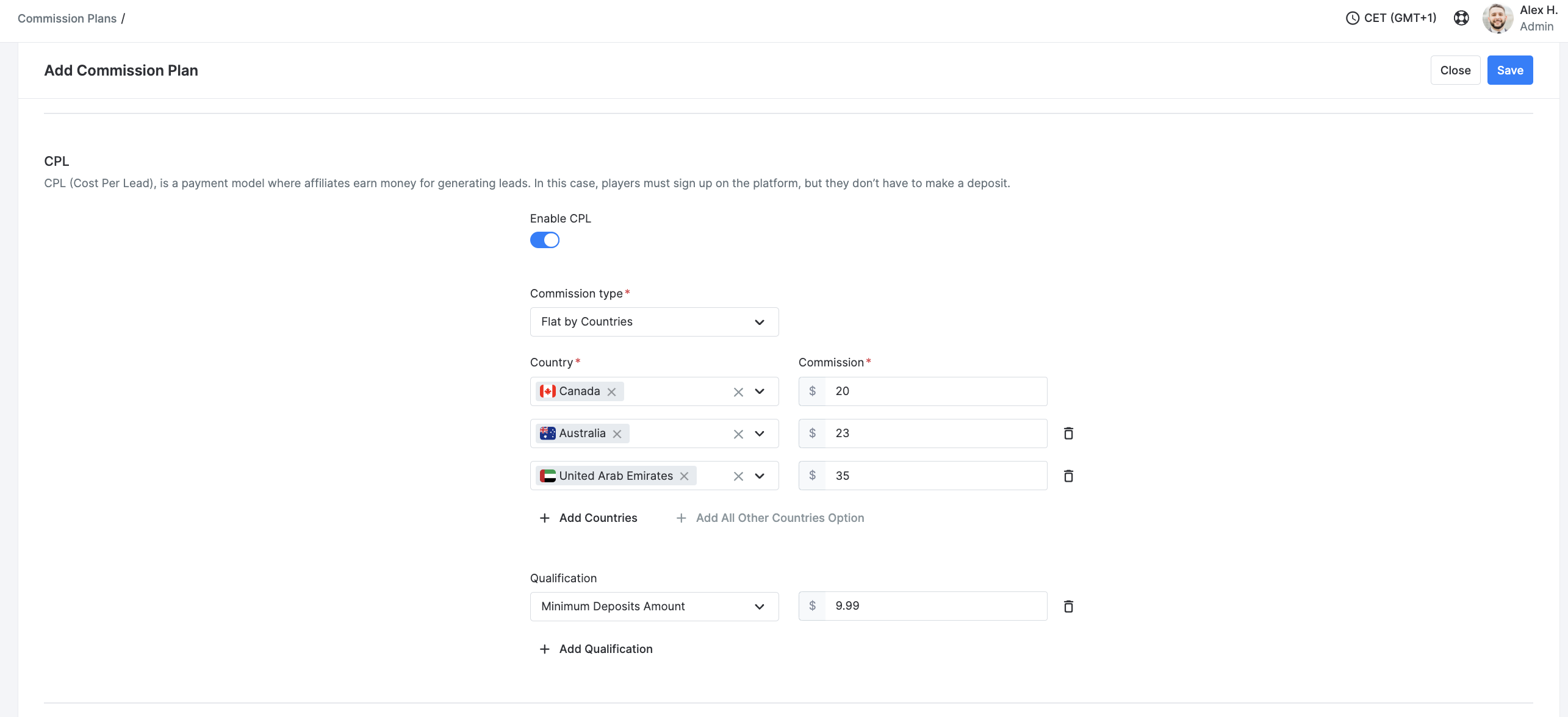
A CPL (Cost Per Lead) commission plan in affiliate marketing for iGaming is a model where affiliates are compensated for generating leads rather than for direct sales or deposits. In the iGaming industry, a lead typically refers to a user who completes a specific action, such as registering on a gaming platform, but does not necessarily make a deposit or engage in further activity immediately.
Key Features of CPL in iGaming:
- Lead Generation Focus: Affiliates earn a commission each time they successfully refer a user who signs up on the iGaming platform, meeting predefined criteria like filling out a registration form.
- Lower Barrier to Entry: Compared to CPA (Cost Per Acquisition) models, CPL offers a lower barrier for affiliates since the user is only required to sign up, making it easier to convert traffic into leads.
- Targeted Traffic: Affiliates often use targeted marketing campaigns to attract potential gamers who are likely to register, focusing on high-quality leads rather than quantity.
- Predefined Conditions: The commission might be tied to specific conditions, such as the user completing the registration process with valid details or opting for a promotional offer.
- Potential for Upselling: While CPL does not require a deposit, it often sets the stage for future actions, such as making a deposit or participating in games, which could be monetized later on.
This model is particularly beneficial for new or smaller affiliates who might not yet have the ability to drive high-depositing users but can still generate valuable leads for an iGaming platform.
Available options for configuring a CPL commission plan:
- Flat
- Flat by Countries
- Progressive:
- Progressive by Countries
Commission type:
- Range by FTD Amount
- Range by Total Deposits
- Range by Deposits Amount
- Range by FTD Amount
- Range by Total Deposits
- Range by Deposits Amount
List of possible qualification options for CPL configuration:
- Minimum FTD Amount
- Minimum Deposits Count
- Minimum Deposits Amount
- Minimum Bets
- Minimum Bets Amount
- Minimum Trades
- Minimum Trades Volume (Lots)
- Minimum Days since Registration
- Maximum Days since Registration
- Player Status
- Trader Status
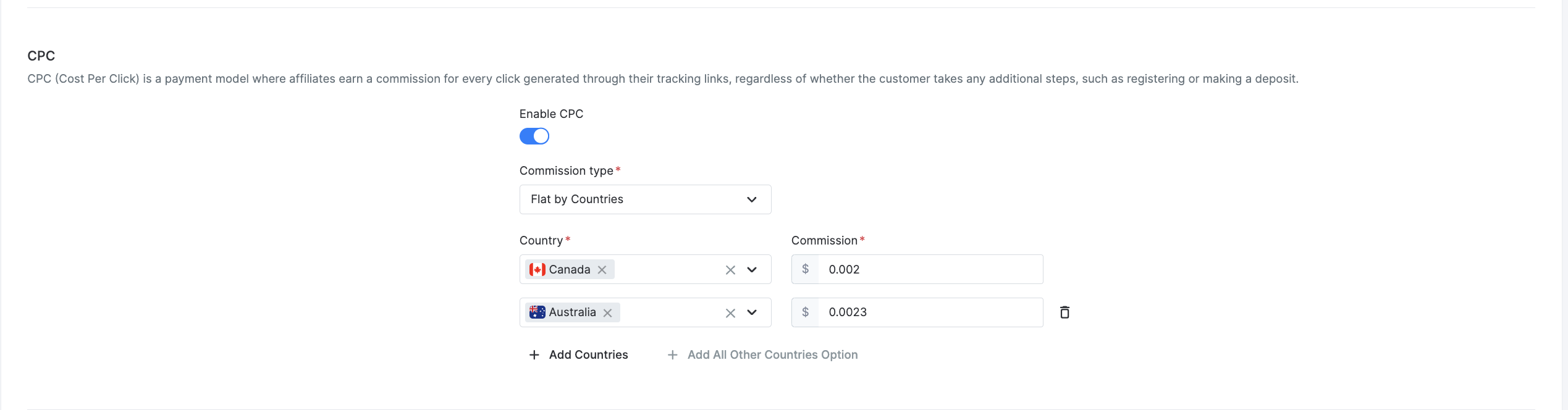
CPC Commission Plan
A CPC (Cost Per Click) Commission Plan payment model in affiliate marketing for iGaming implies affiliates are compensated for every click they generate to the iGaming operator's website, regardless of whether the click leads to a registration, deposit, or other conversion. This model focuses on generating traffic rather than direct conversions, making it an attractive option for affiliates with strong traffic generation capabilities.
Key Features of CPC in iGaming:
- Payment Per Click: Affiliates earn a commission each time a user clicks on the tracking link and is directed to an iGaming operator’s website. The amount paid per click is typically lower than what might be earned under CPA or RevShare models, but the volume of clicks can lead to significant earnings./li>
- Focus on Traffic: Unlike CPA or CPL models, where the focus is on acquiring leads or conversions, the CPC model prioritizes generating as much traffic as possible. This model is often used by affiliates who can drive large amounts of relevant traffic through methods like PPC advertising, content marketing, or social media promotion./li>
- Lower Risk for Affiliates: Since payment is based on clicks rather than conversions, affiliates assume less risk in this model. They get paid for traffic, regardless of whether the traffic results in player registrations or deposits./li>
- Operator Risk: For iGaming operators, the CPC model carries more risk because they pay for clicks without a guarantee that these clicks will convert into paying players. To mitigate this, operators often implement quality control measures, such as monitoring click-to-conversion rates or setting maximum payout thresholds./li>
- Common Use Cases: The CPC model is less common in iGaming than CPA or RevShare models, as operators typically prefer paying for actions that directly lead to revenue. However, it can be useful for brand awareness campaigns or for affiliates who are excellent at generating high volumes of targeted traffic.
The main benefit for affiliates is the simplicity and predictability of earnings. They know exactly how much they will earn per click, making it easier to plan and manage their campaigns. This model can be especially beneficial for content-heavy affiliates who can generate a large volume of clicks through informative or engaging content.
CPC Сommission Plans allow affiliates to earn money based on the traffic they generate, offering a lower-risk option that emphasizes volume over conversion. This model is suitable for affiliates with strong traffic-driving capabilities and for operators looking to increase brand exposure.
Available options for configuring a CPC commission plan:
- Flat
- Flat by Countries
Commission type:
Flat Commission Plan
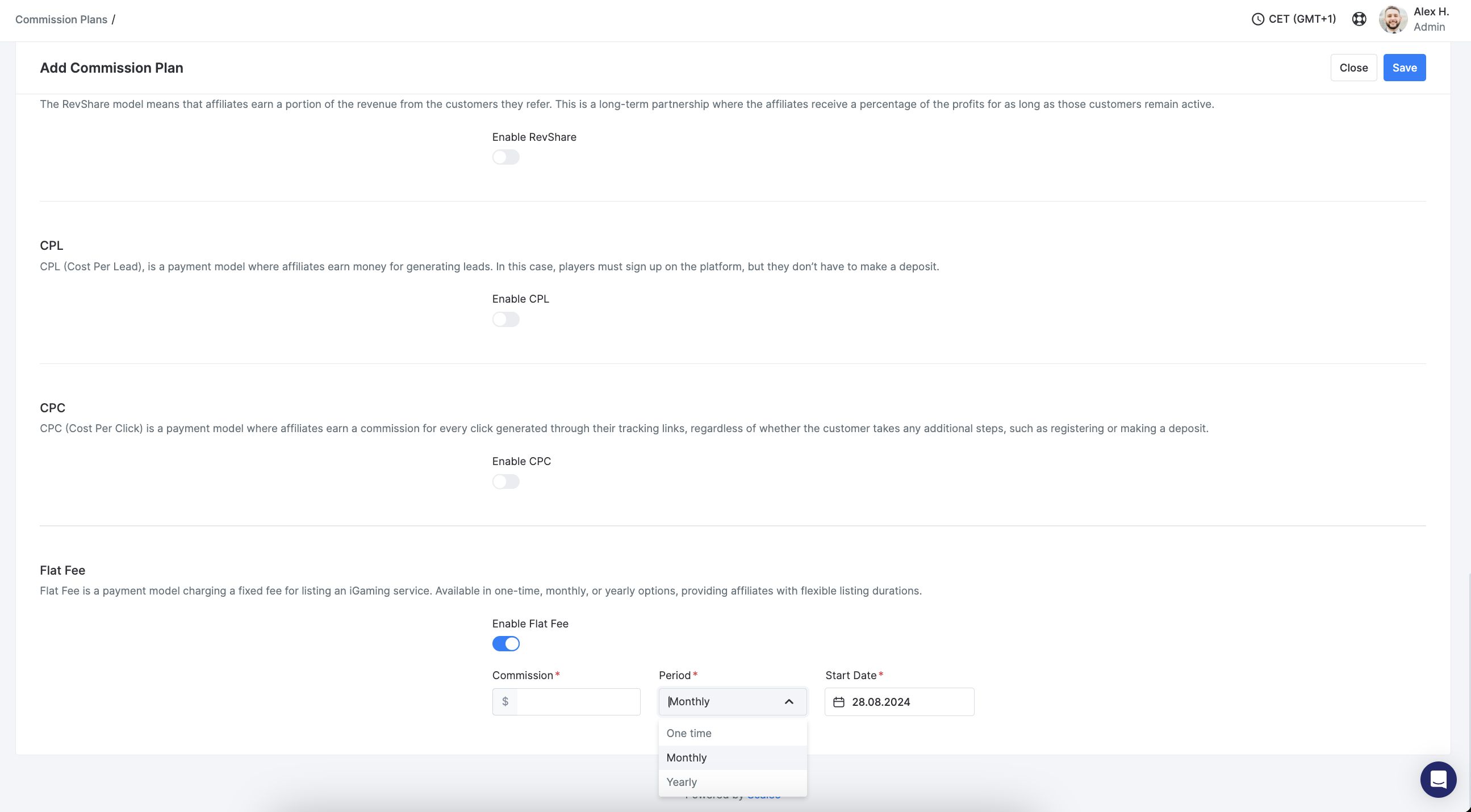
A Flat commission plan in affiliate marketing for iGaming is a compensation model where affiliates are paid a fixed amount. This model provides affiliates with a straightforward and predictable income structure, as the commission remains the same regardless of the value or frequency of the player's activity.
In our system, we have added a separate setting for a fixed commission plan, which involves charging a fixed fee for listing an iGaming service. Options for one-time, monthly, or annual payments are available, providing affiliates with flexibility in choosing the duration of the listing.
Hybrid Commission Plan
A Hybrid commission plan in affiliate marketing for iGaming is a model that combines two or more types of commission structures, most commonly CPA (Cost Per Acquisition) and RevShare (Revenue Share). This plan allows affiliates to earn a fixed amount for each player they refer who meets certain criteria (like registration or first deposit) while also receiving a percentage of the revenue generated by those players over time.
Key Features:
- Combination of CPA and RevShare: Affiliates benefit from an upfront payment (CPA) and a continuous income stream (RevShare).
- Flexibility: This plan is attractive to both affiliates and operators because it balances immediate rewards with long-term earnings.
- Risk Management: For operators, hybrid plans can be a way to manage risk by reducing the long-term payout compared to a pure RevShare plan while still incentivizing affiliates to bring in high-quality traffic.
- Affiliate Motivation: Affiliates are motivated to drive high-quality leads that will not only convert but also continue to generate revenue, as their income is tied to both the immediate conversion and the long-term performance of the players they refer.
This type of plan is particularly popular in the iGaming industry because it aligns the interests of both the affiliate and the operator, ensuring that affiliates are rewarded for both their immediate and long-term contributions to the platform’s success.
Below are several examples of setting up hybrid commission plans combining CPA (Cost Per Acquisition) and RevShare (Revenue Share), with and without qualifications.


